

We believe the most reliable way to keep a smile healthy and attractive is to stay a step ahead of problems. At Iconic Dental Arts, regular checkups and routine care are central to how we look after patients in Oklahoma City and nearby communities.
When you and your family visit us on the schedule we recommend, we can help stop many oral health problems before they begin. We can also slow or halt the ones that have already started. Our skilled, experienced team offers a full range of preventive services, including:
Together, these services make up the foundation of our preventive program.
Your first appointment gives us a clear picture of where your oral health stands today. It also helps us understand what matters most to you about your smile. That picture becomes the baseline we use to track changes at every visit after this one.
We start with a conversation. We go over your medical and dental history in detail. We write down any concerns you have and any symptoms you have noticed, such as sensitivity, soreness, or changes in your bite.
Next comes a careful clinical exam. It includes:
During the exam, we look closely at your teeth, the bone and soft tissues that support them, and the nearby areas of your mouth, head, and neck. We watch for signs that you clench or grind your teeth, and we check how your TMJ (temporomandibular joint) is working.
A thorough oral exam can show more than cavities. It can also reveal how your smile may be affected by:
We want every patient to enjoy a smile that is both healthy and attractive. At Iconic Dental Arts, your exam is done with great care, and everyone on our team pays attention to your comfort and needs.
Once we have reviewed what we found during the exam and on your diagnostic films, we will explain what further treatment, if any, may be needed. We walk you through each of your options, answer your questions, and help you decide what makes sense for you. If you are new to our practice, our new patients page explains what to expect and how to prepare.

A healthy smile does more than look nice. It plays a real part in how well you feel overall. Problems with your teeth, gums, jaws, and the tissues in and around your mouth can affect the rest of your body.
During your oral exam, we check for common problems such as tooth decay and gum disease. We also screen for oral cancer. At the same time, we watch for signs of health issues that may have started somewhere else in the body.
Researchers keep finding new connections between poor oral health and disease elsewhere in the body. A growing body of evidence suggests that dental disease plays a role in a number of health concerns, including:
Digestive disorders
Respiratory problems
Cardiovascular disease
Stroke
Diabetes
Alzheimer's disease
The connection works in both directions. Oral health problems can be tied to illness in the body, and illness in the body can also cause problems in the mouth. Statistics show that more than 90% of all systemic diseases, meaning conditions that affect the body's organs and systems, can produce signs and symptoms in the mouth.
That is why we pay attention to changes such as:
Any of these may point to an underlying medical condition. If we see something that concerns us, we will tell you and talk with you about next steps, which may include a visit to your physician.

A smile that looks great and works well takes ongoing care. Keeping your mouth in top shape depends on several things working together:
Please do not wait until you are in serious pain, or sure something is wrong, before you see a dentist. Many dental problems cause no symptoms in their early stages. A regular checkup and cleaning help keep your smile healthy, comfortable, and working the way it should.
We encourage patients to come in twice a year for a routine checkup and professional cleaning. Visiting on this schedule lets us follow your oral health over time and lower your risk of dental disease. It also helps us catch problems early, when they are usually easiest to treat.
Brushing and flossing at home are the backbone of a healthy smile. Even so, the most dedicated brushers and flossers have trouble reaching every tight spot between the teeth and along the gumline. That is where a professional dental cleaning comes in.
Our hygienist carefully removes plaque and tartar that has built up between your teeth and around your gums, including spots your toothbrush may have missed. Plaque holds the bacteria that cause cavities and gum disease, so clearing it away helps keep those problems from starting.
We finish with a polish that removes surface stains. Most patients leave with a mouth that feels fresh, smooth, and clean.
Checkups and cleanings are also a great time to fine-tune your home care. As your partner in oral health, we will explain and demonstrate the right way to brush and floss. We also share other healthy habits that help protect your teeth and gums between visits. Feel free to ask questions about the products you use, your diet, or anything else on your mind.
Good dental care matters at every age, but childhood is when lifelong habits take shape. Routine checkups, preventive treatment, and teaching that fits your child's age all help protect young smiles from dental disease.
As your children grow, we also keep a close eye on how their teeth and jaws are developing. This helps us see whether orthodontic intervention may be needed to align their smiles. You can learn more about our approach to young patients on our pediatric dentistry page.
Our goal is to help everyone in your family build healthy habits that last for life. At Iconic Dental Arts, we are proud of our reputation for skilled, compassionate care. We work to make each visit a positive one, to build lasting relationships with our patients, and to deliver excellent care. You can read what patients have to say on our reviews page.
We carefully inspect every part of your smile by sight. Still, some things cannot be seen with the eye alone. To view the inner structures of the teeth and the tissues and bone around them, we rely on dental x-rays or radiographs.
Diagnostic x-rays do more than reveal dental disease. They also give us useful details about how your teeth and the structures of your face and mouth are developing, how healthy they are, and how sound they are.
X-ray technology has moved into the digital age. Older film methods needed long exposure times and chemical developing solutions. Digital x-rays are captured, stored, and managed with digital sensors and connected software instead.
Digital radiography has several advantages for patients:
It is faster and uses minimal x-ray radiation.
Images are ready to view right after they are taken.
Images can be shared electronically.
Digital radiographs need no developing chemicals, produce less waste, and are better for the environment.
Images go straight into your electronic file, where they are easy to view on a screen, share, or print.
Because the images appear on a screen in moments, we can review them with you during your visit. That makes it easier to see exactly what we are talking about when we explain our findings.
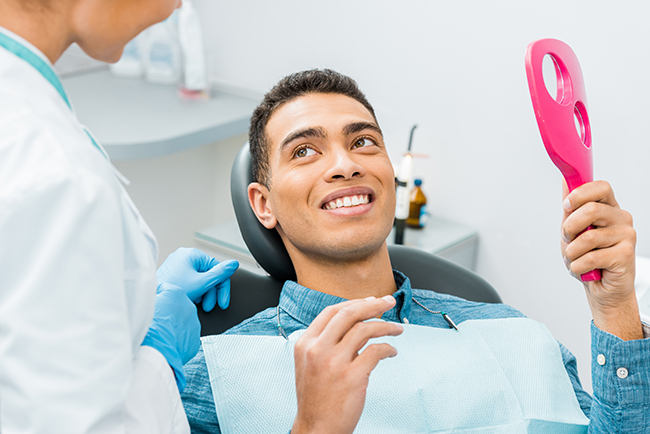
The images we recommend depend on why you are visiting and what your oral health needs are. Not every patient needs every type of x-ray at every visit.
Here are some of the most common diagnostic films and what each one helps us see:
Periapical x-ray: This small film usually focuses on a single tooth. It shows the whole tooth, from the top of the crown to the tip of the root, along with the nearby bone.
Bitewing x-ray: This small film gives close-up views of the crowns of the premolars or molars. It is most often used to look for tooth decay.
Full Mouth Series: This set combines bitewing and periapical views of every tooth.
Panoramic Film (panorex): This film offers a 2D panoramic view of all the teeth and both the left and right sides of the jaw. It shows erupted teeth, developing teeth, and impacted teeth, and it lets us assess the health and soundness of the jawbone.
Cephalometric Film: This film shows a side profile of the face and jaws. Orthodontists often use it to evaluate how a patient's facial bones and jaws are growing.
Detailed three-dimensional images can also be captured for diagnosis, treatment planning, and care. With Cone-beam computed tomography (CBCT), your dentist can capture, study, and rebuild 3D images of a patient's teeth, jaws, and surrounding anatomy. This technology is often used for diagnosis, surgical planning, treatment, and precise placement of dental implants.
Regular exams are one of the simplest ways to protect your smile and your overall health. If it has been a while since your last checkup, or you are looking for a new dental home for your family, we would be glad to see you.
Our office is located at 8200 N May Ave, Oklahoma City, OK 73120. Call us at (405) 943-8575 or visit our contact page to request an appointment. If you have questions about payment options, our financing page is a helpful place to start.
An oral exam is a careful check of your teeth, gums, bite, jaw joints, and the soft tissues of your mouth. It helps your dentist spot problems early, often before you feel any symptoms.
Many dental conditions are quiet at first, so regular exams are one of the simplest ways to protect your smile.
Most exams are comfortable. Your dentist looks at and gently feels your teeth, gums, and jaw, and may take x-rays. If you have sensitivity or soreness, tell our team so we can take extra care.
Comfort is a priority for everyone on our team, so speak up anytime during your visit.
The length depends on your needs. A first visit often takes longer because we review your medical and dental history, talk through your concerns, and complete a full exam. Visits that include a cleaning or extra x-rays may also take more time.
Our team can tell you what to expect when you schedule.
It helps to be ready to talk about your medical and dental history, any medications you take, and any symptoms you have noticed, such as sensitivity or changes in your bite.
Not necessarily. The images we recommend depend on why you are visiting and what your oral health needs are. Diagnostic films are taken as needed to complete your exam.
Your dentist will explain which images, if any, make sense for you and why.
Digital x-rays are faster and use minimal radiation. Images appear on screen right away, so we can review them with you during your visit. They also need no developing chemicals, which is better for the environment.
Your dentist will only recommend images that are useful for your care.
Yes. Along with decay, we check for gum disease, signs of clenching or grinding, how your TMJ is working, and changes in the soft tissues, including an oral cancer screening.
Mouth changes such as dry mouth, sores, or gum problems can sometimes point to a health issue elsewhere, and we will talk with you about next steps if we see something concerning.
We review what we found during the exam and on your films, then explain what further treatment, if any, may be needed. We walk you through your options, answer your questions, and help you decide what makes sense for you.
If something may relate to your general health, we may suggest a visit to your physician.
Yes. Childhood is when lifelong habits take shape, and routine checkups help protect young smiles. As children grow, we also watch how their teeth and jaws are developing, which helps us see whether orthodontic care may be needed.
Visits include teaching that fits your child's age.
Absolutely, and that is the best time to come. Many dental problems cause no symptoms in their early stages, so waiting for pain can allow them to progress.
We encourage visits twice a year for a checkup and cleaning, so we can follow your oral health over time and catch concerns early.

Family, cosmetic and implant dentistry in Oklahoma City, building iconic smiles that last a lifetime.
8200 N May Ave
Oklahoma City, OK 73120